MinHash LSH Ensemble
Containment
Jaccard similarity is great for measuring resemblance between two sets, however, it can be a biased measure for set intersection. This issue can be illustrated in the following Venn diagrams. The left pair (Q and X) have roughly the same intersection size as the right pair (Q’ and X’). But the Jaccard similarities, computed as \(\frac{|Q \cap X|}{|Q \cup X|}\) and \(\frac{|Q' \cap X'|}{|Q' \cup X'|}\) respectively, are very different, with the latter being much smaller, because its union size \(|Q' \cup X'|\) is much larger. This shows that Jaccard similarity is biased when measuring intersection size, as large sets are penalized.

We can use a better measure for intersection, called containment. It is computed as the intersection size divided by the size of one of the set, in this case Q.
It soon becomes clear why we use Q in the denominator, when you think about this search problem: suppose you have a large collection of sets, given a query, which is also a set, you want to find sets in your collection that have intersection with the query above a certain threshold. We can think of the query as set Q, and an arbitrary set in the collection as X. Since the query set here is fixed (for a specific search problem), the denominator \(|Q|\) is a constant, and the intersection size is solely determined by the containment. Thus, we can search for sets in the collection with containment above a certain threshold instead, and the containment threshold can be easily deduced from the intersection threshold by multiplying \(|Q|\).
Another way to think about containment: it is a “normalized” intersection (with value between 0 and 1), which measures the fraction of the query set Q contained in X.
LSH for Containment
Similar to MinHash LSH, there is an LSH index for containment search –
given a query set, find sets with containment above a certain threshold.
It is LSH Ensemble by E. Zhu et al.
This package implements a slightly simplified version of the index,
datasketch.MinHashLSHEnsemble.
The full implementation is in Go. It can be found at
github.com/ekzhu/lshensemble.
Just like MinHash LSH, LSH Ensemble also works directly with MinHash data sketches.
from datasketch import MinHashLSHEnsemble, MinHash

set1 = set(["cat", "dog", "fish", "cow"])
set2 = set(["cat", "dog", "fish", "cow", "pig", "elephant", "lion", "tiger",
             "wolf", "bird", "human"])
set3 = set(["cat", "dog", "car", "van", "train", "plane", "ship", "submarine",
             "rocket", "bike", "scooter", "motorcyle", "SUV", "jet", "horse"])

# Create MinHash objects
m1 = MinHash(num_perm=128)
m2 = MinHash(num_perm=128)
m3 = MinHash(num_perm=128)
for d in set1:
    m1.update(d.encode('utf8'))
for d in set2:
    m2.update(d.encode('utf8'))
for d in set3:
    m3.update(d.encode('utf8'))

# Create an LSH Ensemble index with threshold and number of partition
# settings.
lshensemble = MinHashLSHEnsemble(threshold=0.8, num_perm=128,
    num_part=32)

# Index takes an iterable of (key, minhash, size)
lshensemble.index([("m2", m2, len(set2)), ("m3", m3, len(set3))])

# Check for membership using the key
print("m2" in lshensemble)
print("m3" in lshensemble)

# Using m1 as the query, get an result iterator
print("Sets with containment > 0.8:")
for key in lshensemble.query(m1, len(set1)):
    print(key)
Benchmarks
LSH Ensemble partitions the indexed sets by size and tunes the LSH
parameters separately for each partition, so more partitions
(num_part) help in proportion to how skewed the set sizes are. The
benchmark below makes that concrete: containment threshold queries on a
synthetic corpus, with num_part on the x-axis and one figure per
index-size distribution, comparing the ensemble against a linear scan
(benchmark/indexes/lshensemble_synthetic_benchmark.py). Each query is
a fixed 200 tokens with planted neighbours spread across containments
(0.05–0.95); queries are held out of the index; ground truth is exact
containment at or above the threshold of 0.5. The linear scan converts
the MinHash Jaccard estimate of every indexed set to a containment
estimate and thresholds it – it does not depend on num_part, so it
is drawn as a reference line.
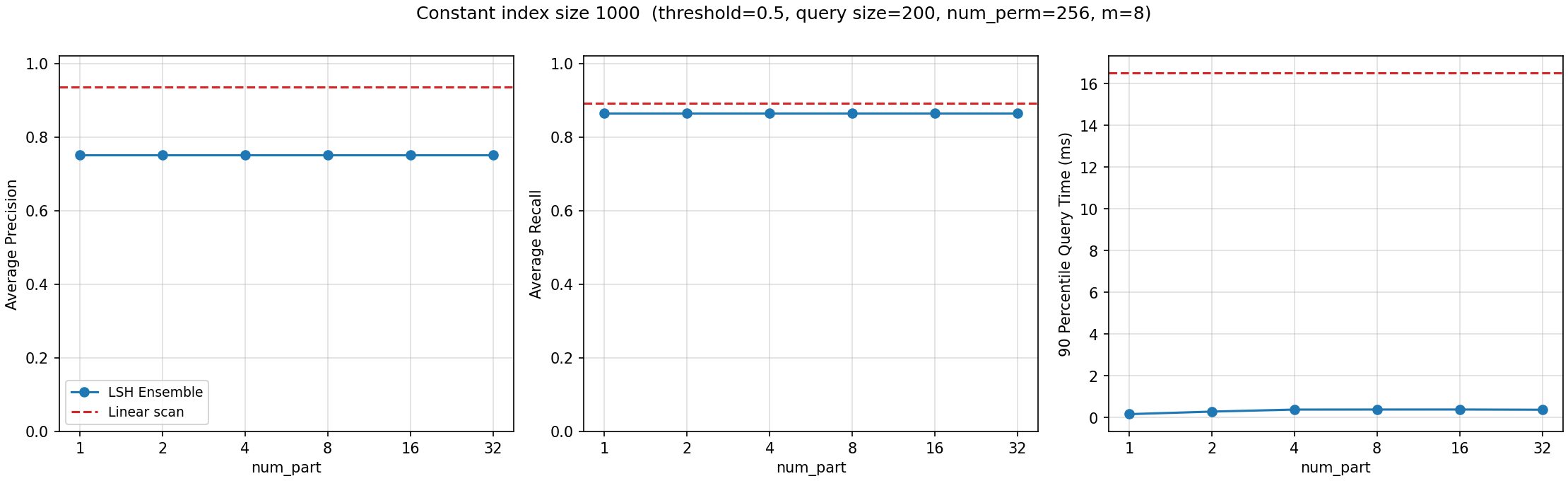
No skew: partitioning cannot help. When every indexed set is the
same size there is nothing to partition by, so the optimal partitioning
is degenerate and accuracy is flat across num_part.
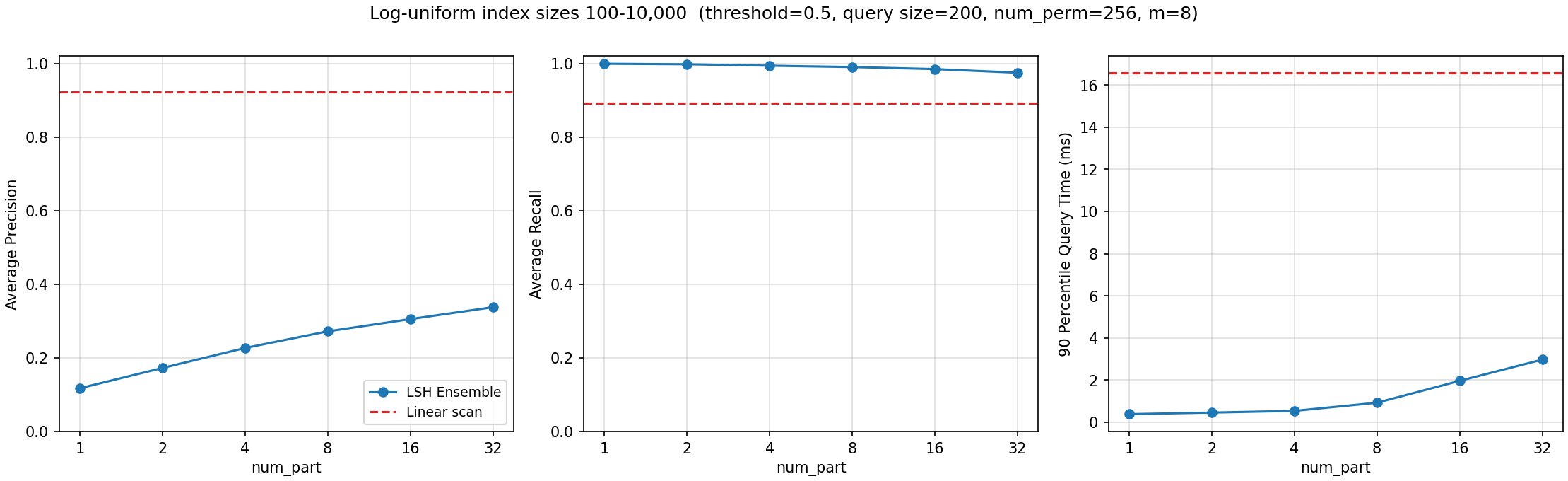
Moderate skew: a modest, saturating gain. With log-uniform sizes spanning 100 to 10,000 tokens, a single partition must compromise across the whole range; partitioning recovers some precision (about 0.12 to 0.34 from one partition to 32) but with diminishing returns.
Heavy skew: partitioning pays off strongly. Real open-data corpora have power-law cardinalities – most sets small, a heavy tail of very large ones (the shape the LSH Ensemble paper models; here the median set is ~170 tokens with a tail to 10,000). Precision climbs from 0.15 with one partition to 0.69 with 32 (a 4–5x gain), because optimal partitioning confines the heavy tail of large sets – whose equivalent Jaccard thresholds are near zero and would otherwise flood every query with candidates – to a few partitions of their own, letting the many small-set partitions run with tight parameters.
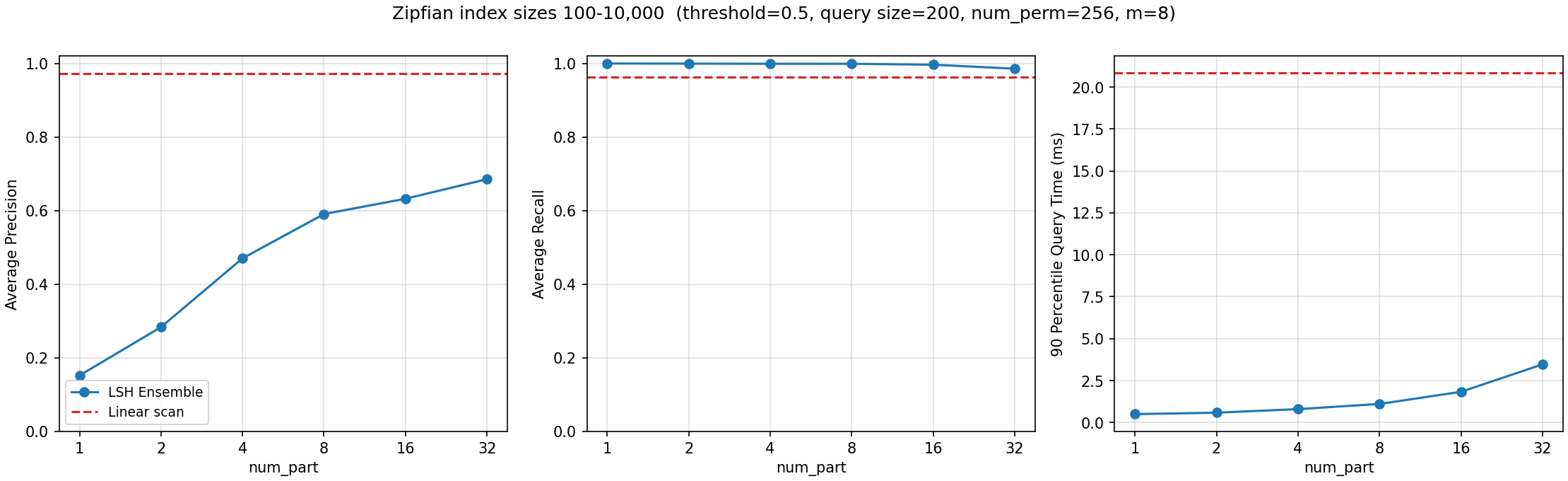
Across all three, recall stays high (near or above the scan) while query
time grows with the partition count but remains well under the scan’s –
so partitioning trades a little speed for precision. Two caveats when
reading the absolute numbers. The ensemble returns candidates –
everything that collided in some partition’s bands – so its precision is
meant to be lifted by verifying candidates against the query (with exact
containment, or the same estimate-and-convert the scan uses); the gap up
to the scan’s reference line is what such a check recovers. And
containment of a small query in a much larger set is a tiny Jaccard
similarity, which MinHash estimates with large relative noise, so heavy
skew is intrinsically hard for any method built on these sketches –
more permutations (num_perm) soften it.
There are other optional parameters that can be used to tune the index;
see the documentation of datasketch.MinHashLSHEnsemble.